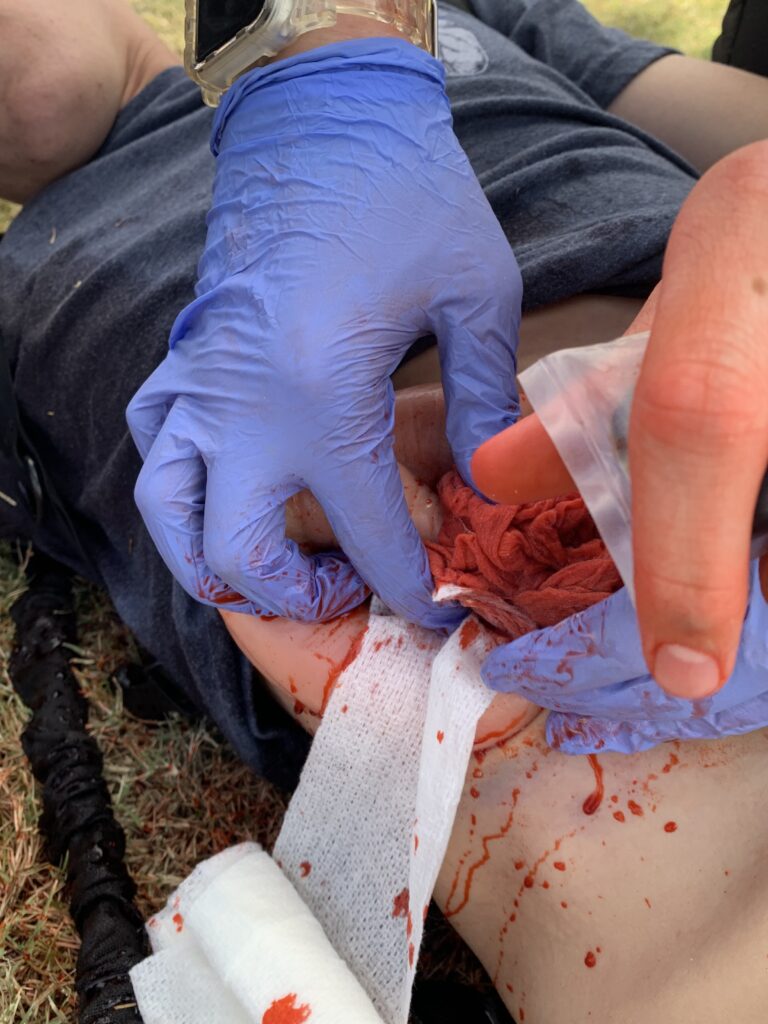
Optimizing Law Enforcement Medical Training and Equipment Deployment

By: Deputy Brandon Griffith
In an age of mass violence, delayed medical response, and the continued evolution of law enforcement responsibilities, proper deployment of medical programs within police agencies is critical. Ensuring that law enforcement be provided reality-based medical training and their lifesaving medical equipment be available and optimally placed where they need it most can be difference between life & death for officers, victims, and bystanders.
Training Without Stress is Just Practice
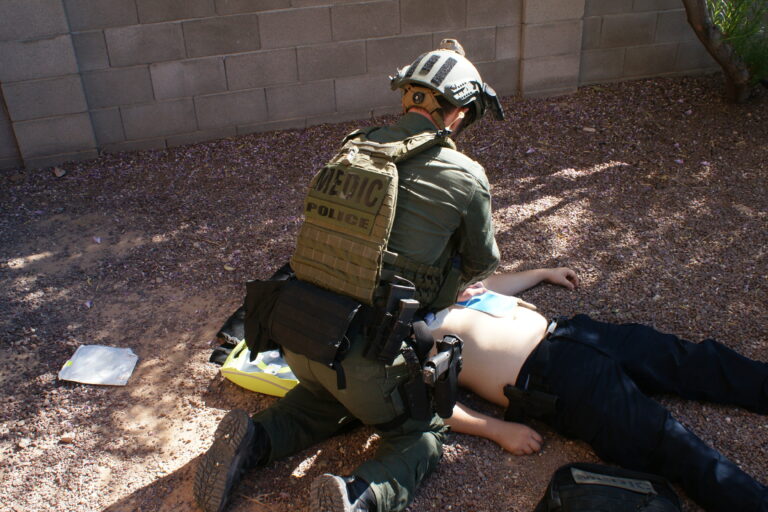
Modern policing requires law enforcement to operate in unpredictable, high-stress conditions. Traditional civilian first aid or CPR training does not meet the demands of today’s law enforcement environment. Reality-based medical training-that is, training conducted under stress, with simulated threats, time constraints, law enforcement variables, and realistic environmental conditions-better prepares officers for actual life & death emergencies.
Research shows that stress inoculation training enhances both skill retention and performance under pressure (Grossman & Christensen, On Combat: The Psychology and Physiology of Deadly Conflict in War and in Peace, 2008). Reality-based medical training provides law enforcement a blueprint to draw from in actual emergencies.
The key takeaway: training must replicate operational stress to ensure law enforcement effectively apply their medical skills in the moments that matter most.
Developing High-Performance Medical Skills
High-performance medical skills go beyond box check first aid courses and basic trauma intervention. Law enforcement must be trained in:
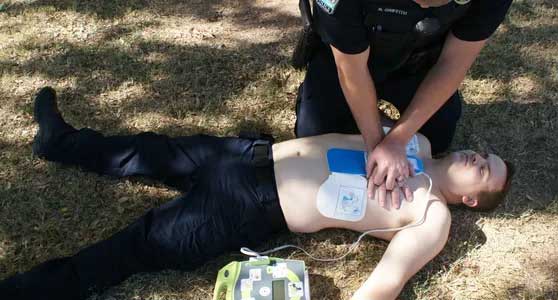
- High-performance resuscitation and AED applications with proficiency metrics and evaluations.
- Rapidly perform patient assessments.
- Apply appropriate emergency bleeding control techniques with precision and speed.
- Recognition of opioid overdoses and treatment options based on patient decline.
- Conduct casualty extractions safely within evolving tactical conditions.
- Communicate medical needs effectively to responding EMS units.
Studies from the Journal of Special Operations Medicine highlight that law enforcement officers trained in TCCC principles significantly increase survivability in active threat environments (Callaway et al., JSOM, 2015). Programs designed for law enforcement emergency medical response of front-line personnel are a necessity. Law enforcement is not protected by good Samaritan laws and are “required” first responders across the US. If your personnel are still doing “box check” medical training designed for civilians in classrooms with no stress, then you’re doing your agency and community a disservice.
Strategic Placement of Lifesaving Equipment
The Problem with Supervisor-Only Medical Gear
A frequent logistical misstep in law enforcement medical program deployment is the concentration of medical equipment-such as medical bags, AEDs, advanced mass casualty bleeding control kits-in supervisor or command vehicles. While logical, from an administrative or budgetary perspective, this strategy often minimizes accessibility during the initial critical minutes of medical emergencies.
Supervisors typically arrive after patrol personnel have already secured the scene and initiated lifesaving care. The critical initial minutes of care are lost while waiting for lifesaving equipment to arrive. For every minute someone is in sudden cardiac arrest, the chances of survival decrease 7-10% (Ibrahim WH, Postgrad Med J. 2007). A patient can bleed out from an arterial bleed in 2-5 minutes (Marrone M, Bellantuono L, Diagnostics (Basel). 2023). Evidence and after-action reviews from numerous active shooter and mass casualty incidents demonstrate that immediate access to medical tools by first-on-scene officers results in higher survival rates (FBI Active Shooter Reports, 2013–2022).
Conclusion: Specialized medical equipment should be deployed with the first responders who arrive first-not stored with personnel who respond later in the chain of events.
Population Density Considerations
- Urban Areas: High call volume, dense populations, and multiple law enforcement response justify distributing AEDs, medical bags, Naloxone, and individual trauma kits “IFAKs” to all patrol personnel, school resource officers, SWAT, and community response units. The rapid arrival of multiple units means each should carry gear to treat multiple patients on a scene.
- Rural Areas: Law enforcement officers may be the sole responders for extended periods, often arriving far ahead of EMS. In these regions law enforcement are the difference between life and death. Personnel should carry more comprehensive medical equipment- AEDs, bleeding control gear, chest seals, hypothermia prevention materials, etc. Patrol vehicles should be equipped to account for long transport times and limited medical personnel availability.
A Layered Medical Equipment Deployment Strategy
An effective law enforcement medical program incorporates a layered distribution model:
- Individual Officer kits (IFAKs)- for immediate self-aid and first response.
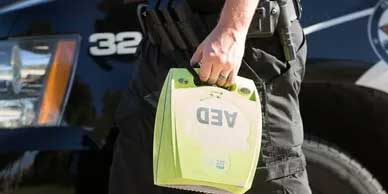
- Patrol vehicle medical equipment (AED, trauma packs)-to treat multiple victims when resources are delayed.
- Specialized response kits (SWAT Medic bags, MASS casualty bags, supervisors, etc.)-Containing specialized gear for extended care, scene management, and operational needs.
This approach balances coverage, accessibility, and operational effectiveness.
Conclusion
The success of a law enforcement medical program is determined not by the amount of equipment purchased but by the systems of care which sustain it, and how effectively it is dispersed and applied under pressure. Agencies should prioritize:
- Reality-based medical training
- Systems of care (policies, dispatch protocols, legislative compliance, sustainability, chain of command, etc.)
- Strategic placement of equipment where law enforcement personnel are most likely to use it- the ones who arrive first.
Moving lifesaving resources out of supervisor vehicles and into patrol-level deployment ensures timely, lifesaving interventions when and where they are most needed.
References
- Ibrahim WH. Recent advances and controversies in adult cardiopulmonary resuscitation. Postgrad Med J. 2007 Oct;83(984):649-54. doi: 10.1136/pgmj.2007.057133. PMID: 17916874; PMCID: PMC2600120.
- Marrone M, Bellantuono L, Stellacci A, Misceo F, Silvestre M, Zotti F, Dell’Erba A, Bellotti R. Haemorrhage and Survival Times: Medical-Legal Evaluation of the Time of Death and Relative Evidence. Diagnostics (Basel). 2023 Feb 15;13(4):732. doi: 10.3390/diagnostics13040732. PMID: 36832220; PMCID: PMC9955172.
- Callaway, D. W., et al. (2015). Tactical Emergency Casualty Care (TECC): Guidelines for law enforcement officers. Journal of Special Operations Medicine.
- Grossman, D., & Christensen, L. (2008). On Combat: The Psychology and Physiology of Deadly Conflict in War and in Peace. Warrior Science Publications.
- Federal Bureau of Investigation (FBI). (2013–2022). Active Shooter Reports.